
It’s amazing how many contractors are still looking for a “Silver Bullet” solution to mold. Ideally we would have some magical pixie dust you sprinkle on a home or building to make it mold-proof, or better yet, to cure all existing mold issues forever.
In this attempt to find the “Holy Grail” of mold, many have flocked to mold testing and remediation seminars that promise to give you all the knowledge of an industrial hygienist in just two or three days. Good luck!
Many contractors are getting burned by trying to become mold investigators, or worse, mold remediators. If you’re thinking of getting into these professions, do yourself a favor, set up a completely separate corporation that distances your core company from that work.
When it comes to dealing with mold issues the reality is there is no Silver Bullet, just common sense, good documentation and good design, service and installation practices. In our IAQ/Mold seminars we teach three basic tenets for dealing with IAQ and mold issues:
Prevention
Many conditions that lead up to a moldy building can be greatly reduced or eliminated through good design, installation, performance testing, and ongoing maintenance. Testing is key to prevention. Good design is a must, but without testing airflows, temperatures, humidity levels, etc., even the best designs just look good on paper.
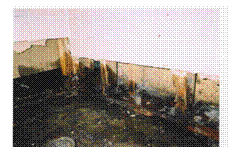 Even if the initial source of moisture is a roof or plumbing leak, we can still have a great effect on whether mold spreads or remains contained in the leakage area. I recently spoke to a member about a brand new home with constant 70+% RH in the winter – in the Northeast! The problem seems to stem from a wet crawl space with no vapor barrier under the slab. Unless the builder takes responsibility for the situation and finds a way to keep water out of the crawl, the problem will only get worse.
Although the moisture issue isn’t the contractor’s fault, he can at least offer some relief, and possibly keep the home from becoming completely infested with growth, by installing a good dehumidification system in the crawl.
In this instance, dehumidification should not be sold as a permanent solution or an admission of guilt. The situation should be well-documented since there’s a good chance of a lawsuit – which brings us to the second leg of the stool.
Protection
 The 3 keys to a good defense when pulled into a mold-related legal situation are documentation, documentation, documentation. Every lawyer I’ve talked to concurs: If you are not at fault, and you document everything: conversations, visits, testing results, etc., the plaintiff’s lawyers hate it!
On the other hand, they love the guys that show up with no documentation and a vague recollection of what happened – case closed – you lose.
Another important component of protection is instituting a company policy and a written protocol for handling moisture-related issues. This insures consistency among all your field people as well as your inside staff. Rather than a looking for a Silver Bullet, it might be wiser to spend time working toward making you company more bullet-proof.
Post-Remediation Solutions
 The third leg of the stool is the big “business opportunity” area in moisture-related situations. Once mold has been identified and remediated by a third party, you can be a real hero by offering to fix what may have caused the situation to escalate in the first place. I’m not talking about fixing roof leaks, leaky pipes, or standing water. Our job is to make sure the comfort system works to minimize airborne moisture and pollutants.
It’s not just about adding dehumidification, air exchangers or UV lamps, although each of these products can be part of the solution. The HVAC equipment and the entire air distribution system need to be evaluated. We need to ask questions like, “Is the equipment sized right? Is it working right? What about draft and combustion air? Can the duct system deliver air in the right amounts to the right places? Is the distribution system tight and sized right? What else can you do to keep the original problem from resurfacing?”
Of all the mold-related opportunities, I believe this is the best and most profitable one. Your customer has just gone through an ordeal they probably don’t want to repeat. Price usually isn’t an objection at this point – they just want it done right and get back to there lives.
A word of caution: when a mold remediation has taken place, before you do anything to the HVAC system, make sure the duct system was cleaned and tested as well.
In several recent mold remediation cases, the ductwork was isolated from the house during cleanup, and no attempt was made at looking inside of the ducts, which by the way were full of mold! An all clear was given for the inside of the home, but after the ducts were reopened, they contaminated everything all over again, and the finger-pointing and lawsuits began all over again.
You’ll likely be dealing with situations like this whether you want to or not. By getting your three-legged stool in place, not only will you sleep better at night, you might just stand to make some well-deserved profit.