
Accurately measuring fan airflow is a critical, yet illusive test that is key to diagnosing the performance of any HVAC system. Our industry poses many methods of finding this essential number, some are great, some are good, and some test methods are purely entertaining. Let’s take a look at each of these test methods and consider the best one for installations that fit your area of the country.
First, What Can You Do With It?
If you measure and know fan airflow, you can easily determine many other essential diagnostic truths from it. If you know the fan is moving 1000 CFM and you measure 800 CFM at the supply registers with a balancing hood, you know the supply duct is leaking 200 CFM.
That’s good to know. Then the duct renovators know where to fix the leaks and how to improve the system. The same is true with the return ducts. Using the example above, if the return grilles total 600 CFM, this reveals 400 CFM of leakage in the return ducts.
It’s also possible to evaluate equipment performance by knowing fan airflow. You can measure equipment generated BTU by multiplying fan airflow by equipment temperature change times the appropriate BTU constant. Compare equipment BTU to the manufacturer’s engineering data to evaluate the effectiveness of current equipment performance. If its only 72% of what’s published, you have work to do.
Once you know equipment BTU delivery, you can subtract system BTU delivery to find the BTU of duct loss in the system. If duct loss is more than 10%, you have found another way to serve the interest, comfort and pocketbook of your customers.
Each heating or cooling system has an ideal airflow to produce maximum efficiency. Fan CFM is the starting point to evaluate the efficiency of each system. Refrigerant charging tables and temperature rise charts each assume a specific airflow through the equipment. Guessing at airflow makes every diagnostic decision that follows simply a guess as well. So, knowledge of fan airflow is essential every time you evaluate the performance of an HVAC system.
Airflow Traverse
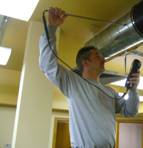 For three hundred years taking an accurate airflow traverse has been the most reliable method of determining fan airflow. The problem we face today is that many installations do not include a length of straight duct sufficient to provide for an accurate traverse. While 10 duct diameters are ideal, 5 or less will do in a pinch.
If you’re lucky enough to live in an area of the country with basement systems, return drops are an ideal place to perform an accurate airflow traverse. Verify the ducting is tight from the traverse point to the fan and a return drop traverse is an excellent way to find fan airflow. A straight metal horizontal duct may provide the same accuracy.
However, many systems may not provide a suitable location for an airflow traverse, so other methods are necessary. A traverse in a plenum is an unsatisfactory test method. Measuring a return grille to find fan airflow may not be accurate due to return duct leakage between the grille and the fan. So other tests are needed to find this illusive number.
Static Pressure and Fan Tables
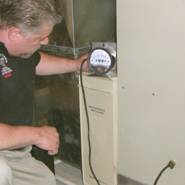 Probably the most used method for determining fan airflow is to measure the equipment’s total external static pressure and fan speed and then plot fan CFM on the manufacturer’s published fan tables. While this method can be extremely reliable, experience is critical to assure accuracy.
Barriers to accurate readings include fan effect, air turbulences, poor fan inlet or discharge ducting and drilling holes in cooling coils, if you’re not careful. But each of these issues is eliminated with time, experience and a drill bit sheath. Taking accurate static pressure reading is an art form that takes a month or so to trust and a lifetime to master.
Pressure Drop Over the Coil
A clean cooling coil is essentially an orifice with a pressure drop published by its manufacturer. Measuring the pressure drop over a coil and plotting the pressure drop on its engineering data is another method of determining fan airflow if the coil is securely fastened to the air handling equipment.
Temperature Rise
In heating mode, temperature rise can be an extremely accurate method of determining airflow. Accuracy is dependent on several factors though. First the discharge temperature must be taken where the probe cannot “see” the heat exchanger or strip heat and be affected by radiant heating, Second, a known heating BTU source must be used.
Heat strips are a known heat source if amperage and voltage are verified, and gas heat is considered reliable if combustion testing and adjustment has been performed to verify BTU output. Assuming the BTU content of the equipment can and often does skew calculated airflow numbers if using the heat rise method.
Flow Plates and Pressurization
These are two building science test methods that work great in the lab, but have been found to produce questionable results in the field. Basically, flow plates are the standard of airflow under laboratory conditions, but when they’re constructed to adapt to varying duct sizes and used at the inlet of a fan in the field, they leave much to be desired. Flow plates change the static pressure of the system and some use questionable methods to correct for the change in fan pressure. Fan pressure changes fan airflow, doesn’t it?
The equal pressure test method involves measuring plenum static pressure and then killing the fan. The instructions say to connect a calibrated fan to the plenum and then ramp up a remote fan connected with a flex duct until the pressure in the plenum matches the live operating condition of the system (when it was alive) The fan airflow is then interpreted and that interpretation is interpreted to be the fan airflow of the operating system. Interpret that one for accuracy.
Master Airflow Measurement
The bottom line is that by this time next year you will be better at measuring airflow than you are today, if you regularly measure airflow. Experience is an essential component in accurately measuring airflow. Often several tests may be combined to increase the tester’s assurance that an accurate reading has been achieved.
Experienced air balancers can, and do, measure and interpret fan airflow thousands of times a day, across the country. Accuracy is from 1% to 5% depending on test conditions using proven air testing and balancing standards and good quality test instruments. Fan airflow is an essential test to assure accurate system diagnostics.